
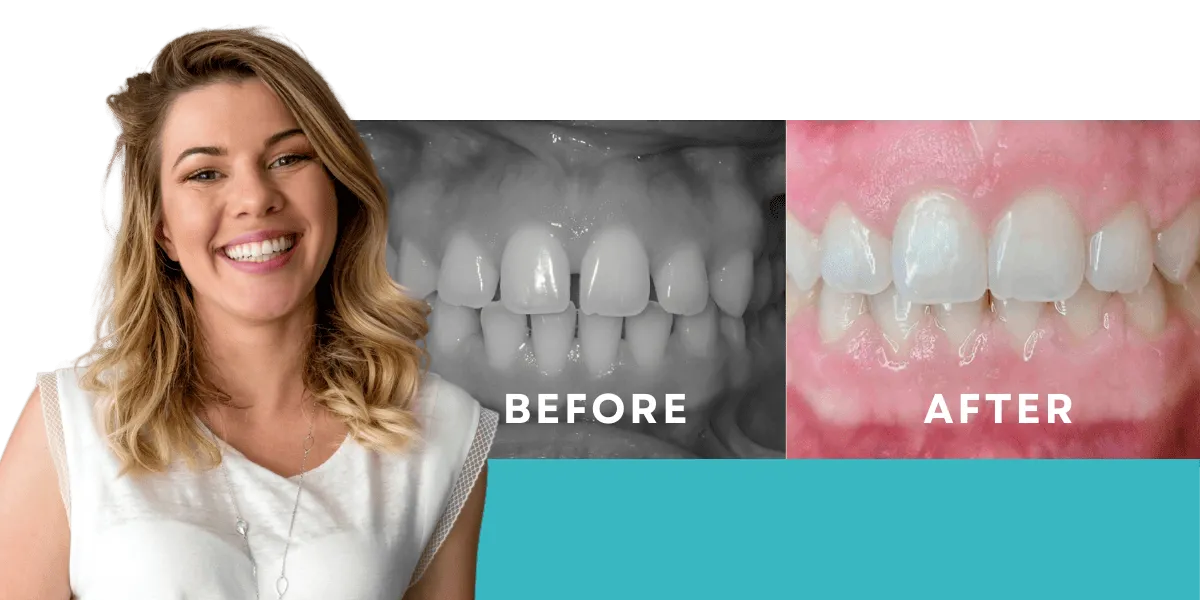
Braces and Invisalign close gaps by moving teeth toward each other until neighboring teeth touch again at their contact points. Most spacing can be treated with either option. The right choice depends on what caused the gap, how large it is and whether your bite needs work as well. Gap teeth can often be corrected in about 3 to 24 months, and a retainer keeps the space from reopening afterward.
Below, we cover why spaces form, how each appliance closes them, how long treatment takes and what keeps the result in place.
What Causes Gaps Between Teeth?
In a healthy bite, every tooth lightly touches the tooth beside it. That meeting point is called the contact. When two teeth do not touch at all, the space is called an open contact, and a gap between the two upper front teeth has its own name: a diastema. Spaces usually trace back to one of a handful of causes.
Genetics plays the biggest role. Your genes shape how your jaw and teeth develop through childhood and the teen years, and some people simply have smaller teeth or a wider jaw, which leaves extra room. Missing teeth are another common cause. If you were born without certain adult teeth, which is more common than many people think, the teeth around that empty spot often drift and leave spaces.
The small band of tissue between your upper lip and gums, called the labial frenum, is sometimes involved too. Some clinicians believe a very strong or tight frenum puts pressure on the bone between the front teeth and holds them apart, although there is debate about how often it is the real cause. Habits matter as well. Thumb-sucking and tongue-thrusting place extra pressure on the teeth, which can push them apart and even change the shape of the jaw. Spacing can also be linked to gum recession.
Why Does Closing a Gap Matter Beyond Looks?
Many people want a gap closed because they feel self-conscious about it, and that is a perfectly good reason. But spaces can also affect how your mouth works. A gap between the front teeth can change the way you form certain words and sounds, while spaces between back teeth can make chewing less efficient.
Food also tends to collect in open spaces. Trapped food raises the risk of cavities and gum disease, and over time gum disease can lead to bone loss. Closing the space removes that trap and makes your teeth easier to keep clean.
How Do Braces Close Gaps?
Traditional braces use brackets bonded to the teeth and an archwire that connects them. The wire applies steady, gentle pressure that guides teeth toward each other, and adjustments every few weeks keep that movement on track.
Braces are a strong choice when a gap is part of a bigger picture, such as several spaces combined with a bite problem. If you want a fixed appliance but would rather not show metal, ceramic braces work the same way with tooth-colored brackets that blend in from a normal conversational distance.
How Does Invisalign Close Gaps?
Invisalign uses a series of custom clear aligners. Each set is shaped slightly differently from the last, so it presses teeth a little closer together until the space is gone. Aligners need to be worn 20 to 22 hours a day, and you move to the next set every one to two weeks, depending on your orthodontist’s instructions.
Our gap teeth before-and-after gallery shows three real BHO cases closed with aligners. One adult had gaps between several teeth and finished with tight contacts and no spaces. A child started interceptive care while her teeth were still shifting naturally and needed nothing beyond Invisalign. A third patient’s front gap had reopened after earlier orthodontic care and a frenectomy, and aligners closed it again. As a Sapphire provider, a status held by the top 1% of certified providers, our team plans a high volume of Invisalign treatment, and spacing cases are a regular part of that work.
| Ways to Close Gaps Between Teeth | |||
|---|---|---|---|
| Braces | Invisalign | InSmile | |
| How it moves teeth | Archwire pressure on bonded brackets | A series of custom clear aligners | Custom shape-memory wire behind the teeth |
| Appearance | Visible brackets; ceramic blends in | Nearly invisible, removable trays | Hidden behind the teeth |
| Daily responsibility | Care around brackets; avoid hard and sticky foods | Wear trays 20 to 22 hours a day | Oral hygiene and any foods Dr. Madan asks you to avoid |
| Office visits | Adjustments every few weeks | Quick check-ins every few weeks | Check-ins on a schedule Dr. Madan sets |
| Good fit for | Gaps combined with bite problems | Most spacing cases in teens and adults | Mild to moderate spacing |
A third option suits patients who want a fixed appliance nobody can see. InSmile sits behind the teeth and uses a custom-shaped wire to move them, and it can be a good fit for mild to moderate spacing.
Can Veneers or a Dental Implant Fix a Gap Instead?
Sometimes, but the goal is different. Orthodontics moves the teeth themselves, while cosmetic work changes their surface or replaces what is missing. If you are weighing the two, our comparison of braces and veneers walks through how each one fits different smile goals.
Missing teeth deserve a careful plan. When the space is large enough, a surgeon may be able to replace the missing tooth with a dental implant, and orthodontic treatment can position the neighboring teeth to make room for it. When the space is too small for an implant, orthodontics may be able to close it instead. Our post on a missing lateral incisor covers one of the most common versions of this decision.
How Long Does It Take to Close a Gap?
Gap teeth can often be corrected in 3 to 24 months. A single small space between the front teeth sits at the shorter end of that range. Several spaces, a gap left by a missing tooth or spacing combined with a bite problem take longer because more teeth need to move, and they need to end up meeting the opposite arch correctly.
Your timeline also depends on consistency. Aligners only work while they are in your mouth, and missed appointments slow any treatment. At your first visit, digital scans and X-rays let us estimate how long your case should take before you commit to anything.
How Do You Keep a Gap From Coming Back?
Teeth naturally want to drift back toward where they started, and closed spaces are no exception. That is why every treatment ends with retainers. Most patients wear their retainer all day for the first 3 to 6 months after treatment, then switch to nighttime wear, which continues indefinitely.
You can choose between a removable Hawley retainer, a clear Essix retainer or a bonded wire cemented behind the teeth. When a strong frenum attachment is pulling on the front teeth, gum contouring can loosen that tissue and reduce the force that might reopen the space. It can also reshape the gums around the teeth once the gap is closed.
Frequently Asked Questions
Will a gap between my teeth close on its own?
In children, spacing can change as permanent teeth come in, which is one reason the American Association of Orthodontists recommends a first orthodontic visit by age 7. Once the adult teeth are in, moving teeth together takes orthodontic treatment.
Can Invisalign close a large gap?
It often can, and our gallery includes adult spacing cases closed with aligners alone. Whether aligners are the best tool for your gap depends on its size, its cause and your bite, which an exam with scans and X-rays will show.
Does closing a gap hurt?
Braces and aligners both apply gentle pressure, so most people feel some tenderness for a few days after an adjustment or a new set of aligners rather than ongoing pain.
Do I need treatment on my frenum?
Not usually. It is considered only when a strong frenum attachment appears to be holding the front teeth apart, and even then specialists debate how much of a role the frenum plays.
Talk With Our Team About Closing Your Gap
If a space between your teeth bothers you, or food keeps catching in it, an exam will show what caused it and which appliance can close it best. Beverly Hills Orthodontics has helped patients close gaps since 2008, with offices in Beverly Hills, Downtown LA, Studio City and Alhambra. Monthly payment plans with 0% interest are available. Request a free consultation or call or text (310) 785-0770.