
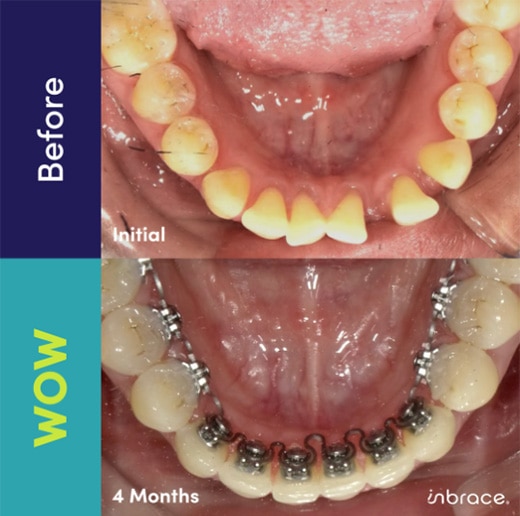
How Important Are Before-and-After Photos When Choosing an Orthodontist?
Before-and-after photos are one of the most useful tools you have, because they show finished clinical work rather than promises. They are most valuable when you look for cases like yours and judge the whole bite, not just the front teeth. Used alone, though, they can mislead, so weigh them alongside credentials, reviews and a consultation.
Most galleries are curated, and that is normal: a practice shows its best work. Your job is to read a gallery the way an orthodontist would. That means knowing which details reveal real skill, which ones are just photography, and which questions to ask about the cases you are shown. Below is how to do that.
What Do Before-and-After Photos Actually Show?
A good set of case photos is closer to clinical records than to marketing, and the best galleries are organized that way.
The starting problem
The before image should make the original issue obvious: crowding, a crossbite, an open bite, a deep bite or spacing. If you cannot tell what was wrong, the after image cannot tell you much about what was achieved.
The finished result
The after image shows where treatment ended. The question is not just whether the teeth look straighter, but whether the specific problem in the before image was actually corrected.
Range of case types
A practice that treats complex bites will show them. Our before-and-after gallery is organized by problem — crowding, posterior crossbite, underbite, open bite, overbite, deep bite, crooked teeth, black triangles, gaps and jaw surgery cases — so you can go straight to the type that matches yours.
The appliance used
Seeing which system treated a case tells you what that practice can achieve with it. Our Invisalign before-and-after page, for example, includes an open bite, a diastema that had reopened after earlier treatment and a severe underbite treated with surgery followed by aligners.
What Should You Look for Beyond Straighter Teeth?
This is where most patients under-read a gallery. Straight front teeth are the easiest part of orthodontics to photograph and the least informative part of the result.
Look at the bite, not just the smile
Side views and views with the teeth together show how upper and lower teeth meet. A finish that looks good from the front but does not close properly at the back is not a complete result.
Check the midline and symmetry
The center line between the upper front teeth should sit close to the center of the lower teeth and the face. Small shifts are common; obvious ones are a finishing detail worth noticing.
Watch the gum line and the spaces between teeth
Even gum contours and closed spaces suggest careful finishing. Small dark triangles near the gums are worth asking about — some are anatomical, some can be improved, and a good orthodontist will explain which.
Look for consistency across many cases
One remarkable transformation can be an outlier. A run of solid results across several cases of the same type tells you far more about what to expect for yourself.
How Should You Compare Galleries From Different Practices?
When you are deciding between practices, compare galleries on the same terms. This side-by-side view keeps the comparison honest.
| What to compare | Stronger signal | Weaker signal |
|---|---|---|
| Case labeling | Each case names the problem treated | Unlabeled smiles with no context |
| Views shown | Front, side and bite views | A single smiling front photo |
| Case range | Several cases of your problem type | Only mild, cosmetic cases |
| Appliance detail | Notes which system treated each case | No mention of how it was treated |
| Complex cases | Surgical or multi-issue cases included | Complex work never shown |
| Consistency | Similar quality across many cases | One or two dramatic standouts |
Compare like with like
Comparing a mild crowding case from one office with a surgical case from another tells you nothing. Pick your problem type and compare across practices.
Read the captions as closely as the images
A short description of what each patient came in with, and what was done, turns a pair of photos into a case you can learn from. Galleries that explain each case are usually run by practices comfortable showing their reasoning.
Notice what is missing
If you have a complex bite and a practice shows only mild cosmetic cases, that does not prove they cannot treat yours, but it is a fair thing to ask about.
How Do Before-and-After Photos Differ by Age and Treatment?
The same gallery can hold very different kinds of cases. Knowing what each kind should show helps you judge it fairly.
Children: look for guided growth
Results in younger patients often involve creating room for incoming teeth or guiding how the jaws develop. The change may look modest in a smile photo but be significant in the bite. Ask what the treatment was intended to achieve.
Teens: look for a complete finish
Most teen cases involve the full permanent dentition, so the after photo should show a finished bite at the back as well as aligned front teeth. This is the group where side and bite views matter most.
Adults: look for complexity handled well
Adult cases often involve earlier treatment that relapsed, worn or restored teeth, or gum changes. Our own galleries include an adult whose space reopened after previous orthodontic treatment and a patient unhappy with treatment received elsewhere. Cases like those show how a practice handles a harder starting point.
Braces versus aligners
Both can produce excellent results. Look at whether the gallery shows the appliance you are considering treating cases like yours, rather than assuming results from one system transfer to another.
Surgical cases
Some severe skeletal problems combine jaw surgery with braces or aligners. These cases show change in the face as well as the teeth, and they are a useful sign that a practice coordinates with surgeons when it needs to.
What Questions Should You Ask About a Gallery?
A few direct questions turn a gallery from marketing into information you can use.
Who treated these cases?
In a practice with more than one orthodontist, it is fair to ask whose work you are looking at, especially if you will be seen by a specific doctor.
Are these typical, or the best?
Every gallery is selective. Asking how representative the cases are, and seeing a few more in person, gives you a more realistic picture.
What did the patient have to do?
Results depend on cooperation as well as skill. Ask what the patient’s part involved — wear time, elastics or retainers — so you know what your own result would ask of you.
What Can Before-and-After Photos Not Tell You?
Photos are evidence of outcomes. They are not evidence of everything that matters in choosing a practice.
Whether the result held
Most after photos are taken when treatment ends. Teeth naturally try to drift back, which is why retainers and a clear retention plan matter as much as the finish. Ask what retention looks like for cases like the ones you are shown.
What the experience was like
A photo cannot tell you whether appointments ran on time, whether questions were answered or how problems were handled. Patient reviews answer that side of the decision.
How long treatment took
Two similar-looking results can involve very different timelines. If duration matters to you, ask how long the cases you are looking at took.
Whether the photos are representative
Lighting, angle and retouching can flatter a result. It is reasonable to ask whether gallery images are unedited and taken in consistent clinical conditions.
How Do You Use Photos During a Consultation?
The gallery gets you in the door. The consultation is where photos become genuinely useful, because they can be tied to your own case.
Bring your own reference points
Screenshot two or three gallery cases that look like your starting point. It gives the orthodontist a fast way to understand what you want and to tell you honestly whether it is realistic for you.
Ask to see cases like yours specifically
Practices usually have far more cases than appear online. Ask to see examples that match your bite, your age group and the appliance you are considering.
Ask what would be different in your case
No two mouths are identical. A good orthodontist will point out where your case differs from the example — root positions, bone, bite or growth — and what that means for the likely result.
Ask to see results years later
Some practices can show cases photographed long after treatment finished. Those images say more about the durability of a result, and about how seriously a practice takes retention, than any photo taken on the day the braces came off.
Ask what a realistic finish looks like for you
The most useful question is often the simplest: given my teeth, what would my after photo probably look like? An orthodontist who answers that honestly, including the limits, is giving you better information than the most polished gallery. Expectations set at the start are what make a result feel like a success at the end.
Look at a preview of your own result
At BHO we start with 5D iTero digital scans, which give an accurate 3D record of where your teeth are today. That record is the starting point for planning, and it makes the conversation about your goals far more concrete than any gallery.
Frequently Asked Questions About Orthodontic Before-and-After Photos
Should I worry if a practice has no before-and-after photos?
It is worth asking why. Most established practices either publish a gallery or can show examples in person. A practice that cannot show any finished cases gives you less to judge it by.
Can I ask to see photos of cases like mine?
Yes, and you should. Describe your concern, and most practices are glad to show relevant examples at the consultation.
Do before-and-after photos guarantee my result?
No. Every case depends on individual anatomy, biology and how closely the plan is followed. Photos are a reasonable indicator of a provider’s quality and consistency, not a promise.
Are reviews more useful than photos?
They answer different questions. Reviews describe the experience; photos show the clinical outcome. Use both together.
See Results Like Yours — Free Consultation
If you have found a few gallery cases that look like your own, the next step is to talk through them with an orthodontist who can examine your bite. Request your free consultation at any of our four Los Angeles-area locations, or call or text us at (310) 785-0770.