
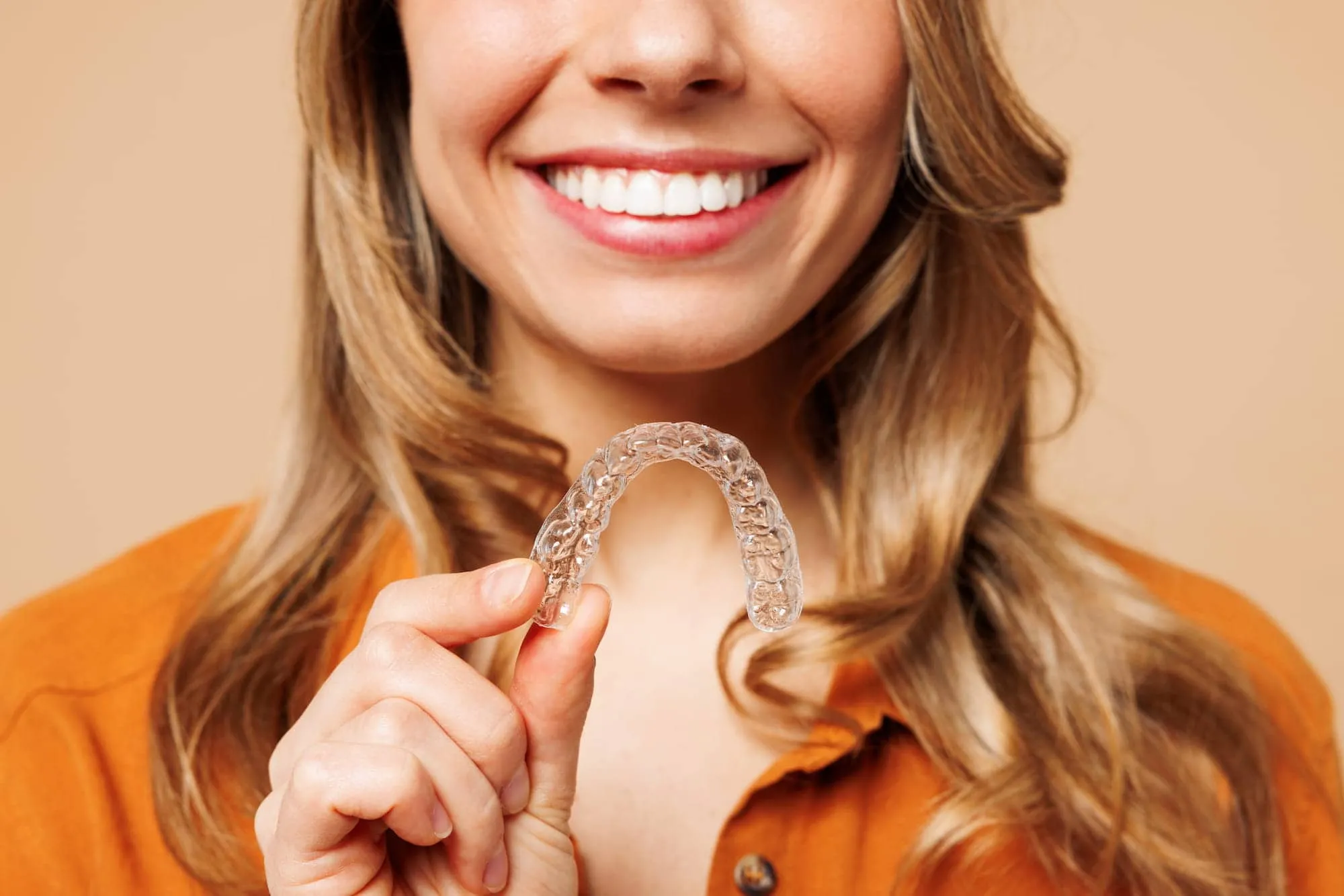
Invisalign is a system of clear, custom-made, removable aligner trays that gradually move your teeth into a healthier position using gentle, controlled pressure. Instead of metal brackets and wires, you switch to a new set of smooth plastic trays roughly every one to two weeks, and each set nudges your teeth a fraction of a millimeter closer to their final position. By the time you finish your series of aligners, your smile has shifted into alignment without anyone necessarily noticing you were in treatment at all.
At Beverly Hills Orthodontics, we’ve been fitting patients with Invisalign for years as a Blue Diamond Top 1% Invisalign Provider, and it’s still one of the questions we hear most at a first visit: what is this stuff actually doing to my teeth, and how is it different from what my friend went through with braces? Here’s the honest, detailed answer.
How Does Invisalign Move Your Teeth?
Every tooth sits in a socket surrounded by a periodontal ligament that allows for tiny amounts of movement. Invisalign works by applying light, steady force to specific teeth through the shape of the aligner itself — each tray is manufactured slightly different from the last one in your series, so wearing it applies pressure in the exact spot needed to guide a tooth toward its planned final position. Your body responds to that pressure by remodeling the bone around the tooth root: bone gently resorbs on the side the tooth is moving away from and rebuilds on the side it’s moving toward, allowing the tooth to drift gradually into place without ever becoming loose.
This is the same underlying biological process that makes traditional braces work. The difference is delivery: braces use brackets and wires to apply continuous, low-level force around the clock, while Invisalign relies on the precise, incremental shape changes built into each tray in the series. Both approaches move teeth the same way biologically — they simply use different mechanical systems to do it.
What Does the Invisalign Process Actually Look Like?
- Digital scan and smile plan. We use a 3D iTero scanner to map your bite in detail — no goopy impressions. That scan captures the exact position of every tooth and how they meet when you bite down.
- Custom aligner series. That scan is used to design your entire sequence of trays, often with a simulation showing how your smile is expected to change step by step over the course of treatment.
- Wearing your aligners. Each tray is worn 20 to 22 hours a day and swapped for the next one in the series on a schedule your orthodontist sets, typically every one to two weeks.
- Check-ins. You’ll come in periodically — usually every six to eight weeks — so we can confirm your teeth are tracking with the plan and make adjustments if needed.
- Retention. Once you finish your active aligners, a retainer holds your teeth in their new position, since teeth can drift back without one.
What Can Invisalign Actually Fix?
Modern Invisalign can treat a wide range of issues, including crowded teeth, gaps between teeth, mild-to-moderate overbites and underbites, and many crossbites. Attachments — small tooth-colored bumps bonded to specific teeth — give the aligners extra grip for more complex movements like rotating a rounded tooth or extruding a tooth further out of the gum line. For very severe bite discrepancies, we’ll sometimes recommend combining Invisalign with other tools like elastics or interproximal reduction, or using traditional braces instead. A consultation with a digital scan is really the only way to know which approach fits your specific case.
How Is Invisalign Different From Just “Clear Braces”?
Invisalign aligners are completely removable, which is the biggest practical difference from any style of braces, including ceramic ones. You take them out to eat, brush, and floss, then put them back in — no food restrictions, no threading floss under wires. That convenience is also the biggest responsibility of the treatment: aligners only work if you’re actually wearing them for the recommended hours each day. Skipping wear time is the single most common reason a case takes longer than planned, since a tooth that isn’t under active pressure simply isn’t moving.
What Does Invisalign Feel Like Day to Day?
Most patients describe the sensation of a new tray as pressure or mild soreness rather than sharp pain, and it typically eases within a day or two as that particular movement gets underway. The plastic itself is smooth, so there’s little of the cheek and lip irritation that can come with metal brackets. Speech can feel slightly different for the first few days with a new tray, especially with certain sounds, but most patients adjust quickly and it’s rarely noticeable to others after the first week.
Frequently Asked Questions About How Invisalign Works
Does Invisalign hurt?
Most patients feel mild pressure or soreness for a day or two after switching to a new tray. That’s a sign the aligner is doing its job — moving a tooth into a new position. It typically fades quickly and is milder than what many people expect from traditional braces adjustments, where an entire archwire is tightened at once.
How often do I need a new aligner?
Most patients switch trays every one to two weeks, though your orthodontist will set the exact schedule based on how your teeth are responding and how complex your movements are.
Can I take Invisalign out for special occasions?
You can remove your aligners for short periods, like a meal, a photo, or a presentation, but they need to go back in quickly. Falling short of 20-22 hours a day on a regular basis will slow your progress or shift your overall treatment timeline.
Is Invisalign as effective as braces?
For mild to moderate cases, Invisalign is often just as effective as braces. For more complex bite corrections — significant rotations, major crowding, or substantial bite discrepancies — braces or a combination approach may be more predictable. Your orthodontist can tell you where your case falls after an exam and digital scan.
How long do most people wear Invisalign?
Total treatment time varies widely based on case complexity, ranging anywhere from a few months for minor cosmetic adjustments to two years or more for comprehensive cases. Most patients fall somewhere between 12 and 18 months.
Curious whether Invisalign is the right fit for your smile? Our team can walk you through your Invisalign options and show you exactly how your treatment would work at a free consultation. For a broader look at how Invisalign compares to braces and other options, see our guide to today’s orthodontic treatment options.